
1. Introduction
Choosing the right blood collection needle is an important part of safe and effective venipuncture. Needle selection can affect patient comfort, blood flow, specimen quality and the success of the blood collection procedure.
The appropriate needle should not be selected based on gauge alone. Healthcare professionals should also consider:
- Vein size and condition
- Patient age
- Blood collection method
- Required blood volume
- Needle length
- Patient mobility and positioning
- Whether a straight needle or butterfly needle is more appropriate
WHO guidance recommends selecting a needle gauge that fits comfortably into the most prominent vein while minimizing discomfort. A needle that is too large may injure the vein, while one that is too small may increase the risk of blood cell damage and affect specimen quality.
2. What Does Blood Collection Needle Gauge Mean?
Gauge (G) refers to the diameter of the needle. Importantly, the gauge number works inversely to needle diameter:
The higher the gauge number, the smaller the needle diameter.
For example:
| Gauge | Relative Size | Common Application |
| 21G | Larger | Routine adult venipuncture |
| 22G | Medium | Smaller or fragile veins |
| 23G | Smaller | Pediatric, elderly and difficult veins |
| 25G | Very small | Selected special applications |
For routine venipuncture, 21G and 22G are commonly considered useful sizes, while 23G butterfly needles can be useful for smaller or fragile veins.
WHO’s published guidance lists 21G for adult venipuncture, 22G for adults and pediatric/elderly patients with smaller veins, and 23G winged sets for pediatric, neonatal and small-vein applications.
3. How to Choose the Right Blood Collection Needle Gauge?
21G Blood Collection Needle
21G is a common choice for routine venous blood collection in adults with healthy, easily accessible veins.
Typical applications include:
- Routine adult blood collection
- General laboratory testing
- Multiple blood collection tubes
- Standard vacuum blood collection systems
A larger internal diameter generally allows efficient blood flow when the vein can accommodate the needle.
22G Blood Collection Needle
22G provides a smaller needle diameter than 21G and can be considered when the patient’s veins are relatively small or fragile.
Potential applications include:
- Elderly patients
- Patients with small veins
- Some pediatric patients
- Difficult venipuncture
- Patients where a smaller needle may improve comfort
23G Blood Collection Needle
23G is commonly associated with butterfly or winged blood collection sets.
It can be particularly useful for:
- Pediatric patients
- Neonatal blood collection
- Elderly patients
- Fragile veins
- Difficult-to-access veins
- Hand or other challenging venipuncture sites
WHO guidance specifically identifies 23G winged sets for pediatric and neonatal applications.
4. 21G vs 22G vs 23G Blood Collection Needles
| Feature | 21G | 22G | 23G |
| Needle diameter | Larger | Medium | Smaller |
| Typical use | Healthy adult veins | Small/fragile veins | Difficult/small veins |
| Adult use | ✓ | ✓ | ✓ |
| Pediatric use | Selected | ✓ | ✓ |
| Elderly/fragile veins | Selected | ✓ | ✓ |
| Butterfly configuration | Available | Available | Common |
| Blood flow | Higher potential flow | Moderate | Lower potential flow |
Important: Gauge selection should be based on the patient’s vein and the collection procedure rather than using one gauge for every patient.
5. Blood Collection Needle Length: Why Does It Matter?
Gauge is only one part of needle selection. Needle length is also important.
Common blood collection needle lengths include approximately:
- 1 inch
- 1.25 inch
- 1.5 inch
- Shorter butterfly needle configurations
The appropriate length depends on the patient’s anatomy, vein location and collection technique.
For example, WHO guidance lists 21G needles at approximately 1–1.5 inches for adult venipuncture and 22G at approximately 1 inch, while 23G winged sets may use much shorter needle lengths for pediatric and neonatal applications.
6. Multi-sample Needle vs Butterfly Blood Collection Needle
There are two major configurations worth considering.
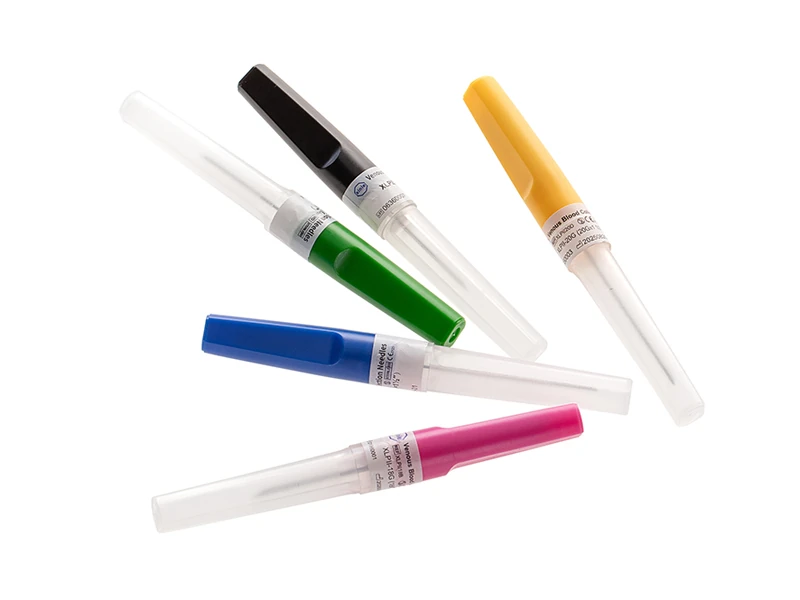
Multi-samples Blood Collection Needle
Multi-samples needles are commonly used for routine venipuncture.
Advantages:
- Simple design
- Suitable for routine blood collection
- Compatible with evacuated blood collection systems
- Efficient for experienced phlebotomists
Butterfly Blood Collection Needle
A butterfly blood collection needle, also called a winged infusion/blood collection set, has flexible tubing and wings that allow better control of the needle.
It can be useful when:
- The vein is small
- The vein is difficult to access
- The patient moves during collection
- The collection site requires greater flexibility
- Pediatric or neonatal collection is required
WHO specifically describes winged butterfly needles as an option for vacuum blood collection systems and pediatric blood sampling.
7. How to Choose a Blood Collection Needle for Different Patients?
Adults with Normal Veins
For a healthy adult with a prominent vein, 21G is a common starting option for routine venipuncture.
Elderly Patients
Elderly patients may have fragile or smaller veins. A 22G or 23G needle may be more appropriate depending on the vein and local clinical protocol.
Pediatric Patients
Pediatric blood collection requires special consideration. 22G or 23G, particularly a butterfly configuration, may be considered depending on vein size and the required blood volume.
Neonatal Patients
Neonatal blood collection requires specialized techniques and equipment. WHO guidance identifies 23G winged needles as an option for neonatal venipuncture.
Difficult Veins
For difficult venipuncture, healthcare professionals may consider a smaller gauge and/or butterfly configuration, depending on the patient’s vein and collection requirements.
8. Why Should You Avoid Choosing the Smallest Needle Automatically?
A common misconception is:
“Smaller needle = less pain = better needle.”
This is not always correct.
The needle must be appropriately matched to the vein and procedure. WHO notes that a needle that is too large can cause vein injury and hematoma, while a needle that is too small may damage blood cells during sampling.
Therefore, the objective is not simply to select the smallest needle.
The goal is:
Choose the smallest suitable needle that can provide reliable blood collection for the intended procedure.
For very small needles, collection conditions and technique can become more important. WHO pediatric guidance, for example, advises avoiding gauges of 25 or more in certain pediatric venipuncture contexts because of increased hemolysis risk.
9. Needle Selection and Blood Collection Tube Compatibility
The needle is only one component of the blood collection system.
A complete system may include:
Blood Collection Needle → Needle Holder → Blood Collection Tube → Laboratory Analyzer
Therefore, laboratories and distributors should evaluate compatibility between:
- Needle
- Holder
- Tube
- Vacuum level
- Tube volume
- Additive
- Collection procedure
The collection method can also influence specimen quality. CLSI’s current PRE02 standard covers diagnostic venous blood specimen collection, including venipuncture and pediatric collection.
10. Blood Collection Needle Safety
For professional blood collection, safety should be considered alongside gauge and length.
A modern blood collection needle may incorporate:
- Safety shield
- Needle protection mechanism
- Winged design
- Needle-stick prevention features
- Sterile single-use packaging
The WHO recommends safety-engineered devices where appropriate to minimize exposure to blood and reduce needle-stick risks.
11. Quick Blood Collection Needle Selection Guide
Start with five questions:
① Who is the patient?
Adult, elderly, pediatric or neonatal?
② What is the vein like?
Normal, small, fragile or difficult to access?
③ What type of collection is required?
Routine venipuncture, difficult venipuncture or specialized collection?
④ What needle configuration is appropriate?
Straight needle or butterfly needle?
⑤ What gauge and length are suitable?
Choose the appropriate combination based on the patient’s anatomy and collection requirements.
12. Blood Collection Needle Selection Chart
| Patient / Situation | Possible Needle Choice |
| Adult with normal vein | 21G |
| Adult with smaller vein | 22G |
| Elderly / fragile vein | 22G–23G |
| Pediatric patient | 22G–23G |
| Neonatal venipuncture | 23G butterfly |
| Difficult vein | 22G–23G butterfly |
| Routine venipuncture | Straight needle |
| Difficult access | Butterfly needle |
Note: These are general reference ranges, not a substitute for institutional protocols, product IFUs or clinical judgment.
13. FAQ: Blood Collection Needle Gauge
What gauge needle is best for blood drawing?
For routine adult venipuncture, 21G is a commonly used option. Smaller gauges such as 22G or 23G may be considered for small or fragile veins.
Is a higher gauge needle smaller?
Yes. A 23G needle is smaller in diameter than a 21G needle.
What is a 23G blood collection needle used for?
23G needles are commonly used for smaller or fragile veins and are particularly associated with butterfly blood collection sets for pediatric, neonatal and difficult venipuncture.
Is 21G or 23G better for blood collection?
Neither is universally better. The appropriate choice depends on the vein, patient, collection system and required blood flow.
What is a butterfly blood collection needle?
A butterfly needle is a winged blood collection device connected to flexible tubing. It provides additional control and flexibility and can be useful for difficult, small or fragile veins.
14. Conclusion
Selecting the right blood collection needle requires more than simply choosing a gauge.
The key factors are:
Gauge + Length + Vein Condition + Patient Type + Collection Method + Safety
For many routine adult venipuncture procedures, 21G is a common option. For smaller or fragile veins, 22G or 23G may be considered, while butterfly needles can provide additional flexibility for difficult venipuncture and pediatric/neonatal applications. WHO and CLSI guidance should be used together with local clinical protocols and the manufacturer’s instructions for use.